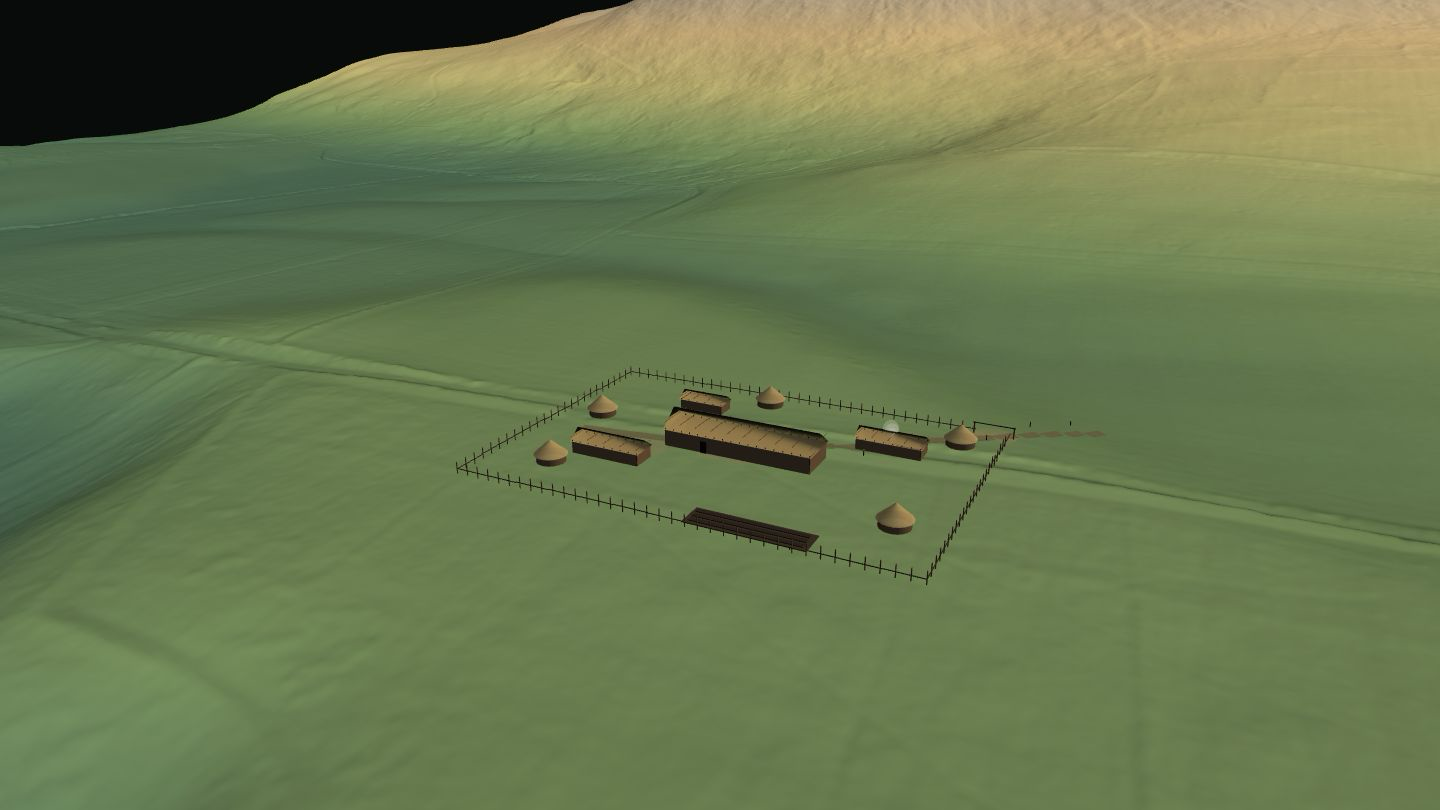
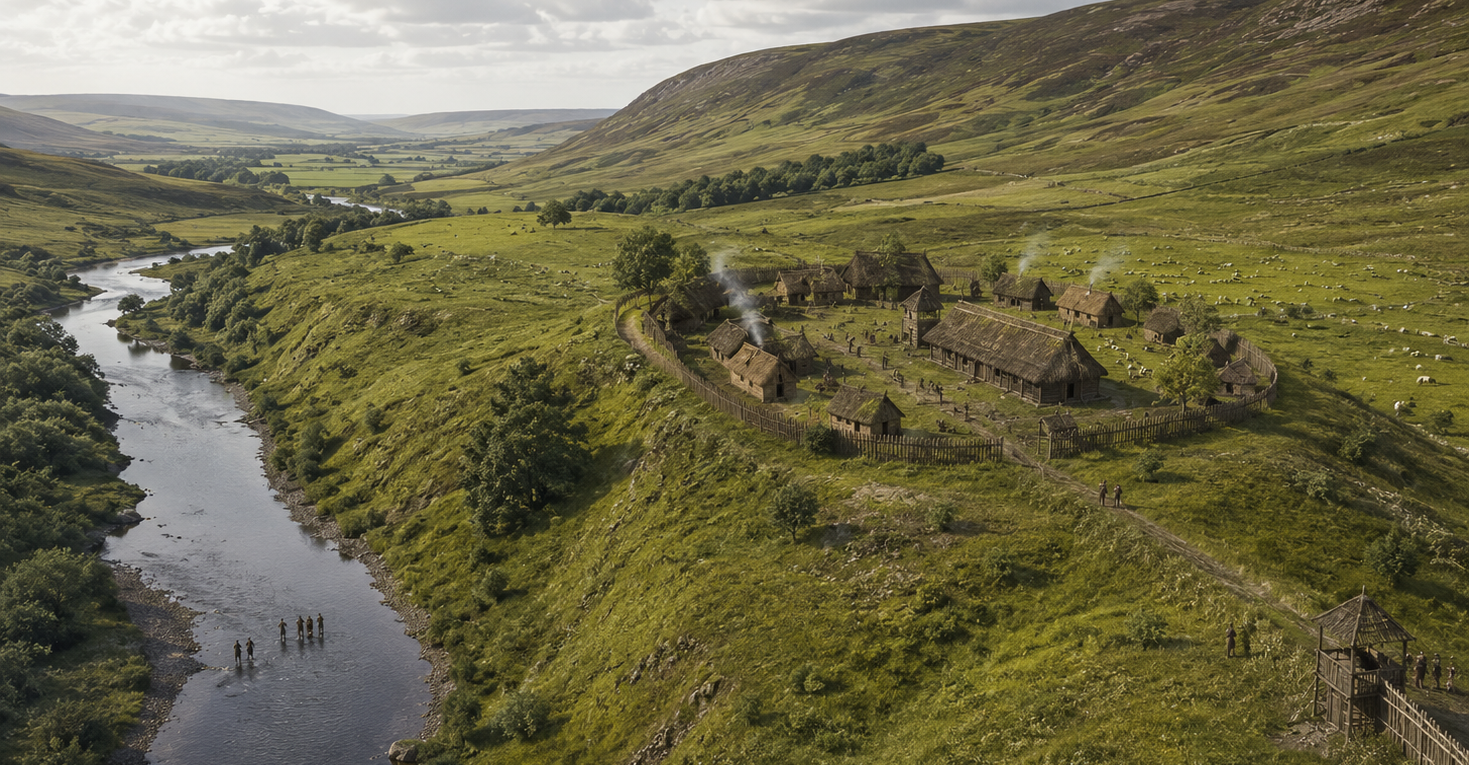
In the foothills of the Cheviots, three miles north-west of the village of Wooler, a long green spur of land rises gently from the valley floor. The river runs beside it. The hills lean over it from the south. To anyone walking past on a summer afternoon it looks like nothing much — pasture, sheep, the wind in the grass. But thirteen hundred years ago a king lived here. His timber hall stood on the rise. His queen's bishop baptised people in the river below for thirty-six unbroken days. And his court — the centre of seventh-century Northumbria, briefly the most powerful kingdom in Britain — gathered at this spot in the long northern summers to hear lawsuits, settle quarrels, drink mead, and rule.
The place was called Ad Gefrin. We know it now as Yeavering.
The Goat's Hill
The name is older than the kingdom. Ad Gefrin is the Old English form — "at the goat's hill" — but the second element, Gefrin, is borrowed from a Brittonic word, gabro-brigā, meaning much the same thing in the language the Britons spoke before the Anglo-Saxons came. The Anglo-Saxons heard the old name on the lips of the people they were displacing and kept it. They added their own preposition and let the rest stand. Many of Northumberland's place names work like this: a layer of Brittonic underneath a layer of Old English, with later layers of Norse and Norman laid on top — the linguistic geology of the land.
The goat's hill itself is not the palace site. That distinction belongs to Yeavering Bell — the bell-shaped peak that rises five hundred feet above the valley to the south, ringed by the largest hillfort in northern England. The Britons of the late Iron Age built a stone-walled enclosure around its summit, big enough to hold a small town. By the seventh century the hillfort was abandoned, but its silhouette dominated the skyline. The Anglo-Saxon kings built their palace not on the hill, but in its sight — on the long flat shoulder of the valley below, where the River Glen ran wide and shallow, and where a great hall could be approached on foot from any direction.
It was a ceremonial choice as much as a practical one. The kings of Bernicia were planting a new centre of power in a landscape that already carried the memory of older powers. Every door of the palace looked towards the hillfort. Every guest who arrived passed under its eye.
The Kingdom of Bernicia
To understand why Ad Gefrin matters, you have to understand what Bernicia was — and what it briefly became.
In the late sixth century, when the Roman Empire had been gone from Britain for two hundred years and the post-Roman British kingdoms were still fighting for survival, an Anglian war-band led by a man called Ida seized the volcanic crag at Bamburgh and made it his fortress. From that single rock, his descendants built a kingdom. They called themselves the kings of Bernicia — from the Brittonic Bryneich, the name the local Britons had used for the country between the Tyne and the Forth. To the south, a sister Anglian kingdom called Deira ran from the Tees down to the Humber. By the early seventh century, the two kingdoms had been joined under a single crown. Their combined territory ran from Edinburgh to Sheffield. They called it Northumbria, the land north of the Humber.
For most of the seventh century, Northumbria was the dominant power in Britain. Its kings collected tribute from the other Anglo-Saxon kingdoms. Its scholars wrote books that were read across Europe. Its monasteries on Lindisfarne and at Jarrow produced the Lindisfarne Gospels and Bede's Ecclesiastical History. This is the period historians sometimes call Northumbria's golden age. And Ad Gefrin sits, briefly but unmistakably, at its bright centre.
Edwin and Æthelburh
The man who turned a hillside meeting-place into a royal palace was King Edwin. He had grown up in exile, hiding from the assassins of a rival who had taken his throne. He came back at the head of an army in 616, killed the king who had stolen his kingdom, and reigned as the most powerful man in Britain for the next seventeen years.
In 625 he married a Kentish princess called Æthelburh. She came north on the long road from Canterbury with her household, her chaplain, and a man called Paulinus — a Roman missionary who had crossed from Italy with the original Augustinian mission a quarter of a century before. Paulinus was now an old man with a hooked nose and a great voice, and he came to Bernicia not as a guest but as a quiet conqueror. The bride brought her religion with her in his person. Within two years Edwin himself had been baptised. A kingdom that had worshipped Woden and Thunor for two centuries was, by stages, becoming Christian.
Ad Gefrin sat at the centre of this transition. It was the king's summer palace, his vill — one of perhaps a dozen royal estates strung across Northumbria where the court would camp for a few weeks at a time before moving on. The Anglo-Saxon kings did not live in capitals; they lived on the road. They consumed the food rents owed to them by the local farmers, dispensed justice, took counsel from their nobles, and rode on. Ad Gefrin was the place they went to in summer, when the days were long and the river was low and the hall could be opened to the breeze.
Bede's Account
Almost everything we know about life at Ad Gefrin comes from one source: the Ecclesiastical History of the English People, written around 731 by the Venerable Bede, a monk in the monastery at Jarrow on the Tyne. Bede was born about thirty years after Edwin's death. He had access to people who remembered the king and the queen, to letters that had survived in monastic libraries, and to the long oral memory of the Northumbrian church. What he wrote about Ad Gefrin is therefore second-hand — but second-hand from people who were there.
Bede tells us that Paulinus, the queen's bishop, came to Ad Gefrin and stayed for thirty-six days. He preached to the gathered crowds. He instructed those who wished to be baptised. And every morning he walked down to the River Glen and waded into the water with the catechumens and baptised them. Thirty-six days of mass conversion, drawn from the surrounding country, in a river that ran cold and clear from the Cheviots. Bede gives no number for the converts. He says only that the catechumens came in such crowds that Paulinus was fully occupied from morning until evening for the whole of his stay.
In this royal villa, the man of God Paulinus stayed with the king and queen for thirty-six days, fully occupied in catechising and baptising. During this time he did nothing from morning till night, but instruct in the Word of Christ those who came flocking to him from every village and district, and when instructed, wash them in the cleansing water of baptism in the river Glen, which is close at hand. — Bede, Ecclesiastical History of the English People, II.14, c.731
Bede also gives us, in the same book, the most famous passage ever written about Edwin's reign. It is not about Ad Gefrin specifically, but about the peace and order the king had imposed on his kingdom — the kind of peace that made gatherings like the one at the river possible:
It is related that there was then such perfect peace in Britain, wherever the dominion of King Edwin extended, that, as is still proverbially said, a woman with her newborn babe might walk throughout the island, from sea to sea, without receiving any harm. The king took such care for the good of his nation that in several places where he had seen clear springs near the highways, he caused stakes to be fixed, with brass dishes hanging at them, for the refreshment of travellers; nor durst any man touch them for any other purpose than that for which they were designed, either through the dread they had of the king, or for the love which they bore him. — Bede, Ecclesiastical History, II.16
That sentence — the woman with the baby walking from sea to sea, the brass cup at the spring beside the road — has echoed through English memory for thirteen hundred years. It is the founding image of a certain kind of English political imagination: the king as the maker of safe roads, the bringer of peace, the man whose authority hangs the cup beside the spring. That is the kind of king Edwin was. And Ad Gefrin was where he held court.
The Hall and the Theatre
The astonishing thing is that we now know, in some detail, what Ad Gefrin looked like.
At the centre of the site stood a great timber hall — thirty metres long, ten wide, built of oak posts driven deep into the chalky subsoil and roofed with thatch and shingle. Its walls were painted with lime-wash and probably hung inside with woven cloth. Its doors faced east and west, so the morning sun fell on the high seat at one end and the evening sun on the doorway at the other. This was the king's hall, his heall: the room where mead was poured, where lawsuits were heard, where the gold rings were given out by the king to his loyal warriors at the long winter feasts. Beside it stood smaller halls for the queen's household, for the kitchens, for the visiting bishops and travelling monks. A timber palisade enclosed the whole.
And then, west of the great hall, stood the strangest building Anglo-Saxon archaeology has ever found.
It was a wooden grandstand. Wedge-shaped in plan, with rows of stepped benches rising in a tight semicircle to a height of perhaps three metres, and capable of holding three or four hundred people. Facing the seats, at the focal point of the wedge, stood a single low platform. The whole structure was built of timber. There is nothing else like it anywhere in early medieval Europe. It is unique to Ad Gefrin.
What was it for? The best guess — the one Brian Hope-Taylor put forward when he excavated it in the 1950s — is that it was the meeting-place of the witan, the king's council. Anglo-Saxon kings governed by consultation with their leading men. They needed a place to assemble those men, address them, listen to them, and pass judgement on whatever was brought before them. At every other royal site we have ever found, the assembly was held inside the great hall. At Ad Gefrin, the king built a separate amphitheatre for it. It is the closest thing to a parliament chamber in the seventh century anywhere in northern Europe.
The Fire
It did not last.
In October 633, Edwin marched south to face an alliance between Cadwallon, the British king of Gwynedd, and Penda, the pagan king of Mercia. They met at Hatfield Chase, near Doncaster. Edwin was killed. His army was destroyed. Cadwallon then turned north and spent the winter ravaging Northumbria, burning royal halls and putting Christians to the sword. He was not, Bede tells us, a king interested in mercy. He intended to wipe out the Northumbrian dynasty altogether.
Ad Gefrin burned. Whether in that winter of 633-634 or in a second wave of destruction a generation later under Penda, the timber halls of Edwin's palace were set on fire. The post-holes Hope-Taylor excavated showed clear evidence of charring. The great hall had ended in flames.
It was rebuilt — possibly by Edwin's nephew Oswald, the saint-king who took back the Northumbrian throne and refounded the Christian church on the island of Lindisfarne. But the rebuilding was modest, and the second hall stood for only one more generation. By the 670s the court had moved a few miles east to a new royal estate called Maelmin, and Ad Gefrin was abandoned. The timbers rotted. The thatch fell in. The ditches silted up. The palisade leaned and dropped. Within a hundred years there was nothing on the surface at all.
A Thousand Years of Pasture
For more than a thousand years, the site of Ad Gefrin was a flat green field beside a river. Sheep grazed on it. Hay was cut from it. The local farmers knew it as a slightly raised area where the soil was stony and the plough sometimes turned up a curious black streak in the topsoil — charcoal, though they did not know what kind. The medieval and Tudor antiquaries knew Bede's text and its mention of "Ad Gefrin", but no one had any idea where the place had stood. Some thought it had been on Yeavering Bell itself, inside the hillfort. Others thought it must have been buried under a later village. Most assumed it was lost beyond recovery.
The site was lost in the way English landscapes lose things best of all: by the simple, patient erasure of pasture. The grass grew over it. The seasons came and went. The cattle stood where the high seat had stood. For thirteen centuries no one knew.
The Aerial Photograph, 1949
And then, on a hot afternoon in the summer of 1949, a man called Kenneth St Joseph flew a small aircraft low over Glendale.
St Joseph was a Cambridge geologist who had taken up aerial photography as a hobby and turned it, almost single-handedly, into a major archaeological technique in Britain. He had noticed during the war that buried features in the soil — old ditches, old post-holes, old walls — produced subtle differences in the way crops above them grew. A buried ditch held more moisture than the surrounding soil; the wheat or barley above it grew taller and greener. A buried wall did the opposite; the crop above it was stunted and pale. From the air, in the right light, these differences appeared as crop marks — the faint outline of a vanished building, drawn in vegetation.
That afternoon over Yeavering, in the dry July light, the field beside the River Glen showed him an entire palace.
Post-holes ten metres deep traced the outline of a great hall. A semicircular wedge of marks showed the grandstand. A palisade ran round the whole. Outbuildings, ditches, enclosures — the plan of a substantial royal complex, drawn in cereals, perfectly legible from the air, completely invisible from the ground. St Joseph took the photograph. Then he took several more.
It would take four more years to organise a proper excavation, and it would fall to a younger archaeologist — Brian Hope-Taylor, then a student of St Joseph's at Cambridge — to dig the place up.
Hope-Taylor's Trowel
Hope-Taylor worked at Yeavering for nine summers, from 1953 to 1962. He had a small team, almost no money, and the constant threat that the field would be ploughed back into use before he could finish. He worked carefully, patiently, with the watercolour brushes and dental picks of a real excavator rather than the spades and barrows of a rougher generation. And what he found, season by season, transformed our understanding of early Anglo-Saxon Britain.
He found the great hall. He found the smaller halls. He found the kitchens, the storerooms, the cemetery. He found the timber palisade, the gates, the ditches. And he found the grandstand, the wedge-shaped amphitheatre that no one had ever seen the like of before, and that no one has ever seen the like of since. He worked out the building sequence: a phase under the British kings before Edwin's grandfather had taken the country, a great expansion under Edwin himself, the burning, the modest rebuild under Oswald, the second burning, and finally the long abandonment.
He published his findings in a single huge monograph, Yeavering: An Anglo-British Centre of Early Northumbria, in 1977. It is one of the most important British archaeological publications of the twentieth century. It is also — and this is rare in archaeological monographs — beautifully written. Hope-Taylor wrote like a man who had stood for nine summers in a field beside a river and felt the weight of a vanished kingdom rise up under his trowel. He never spoke of his work in the language of triumph. He spoke of it in the language of recovery.
The Site Today
If you go to Ad Gefrin now — and you can, freely, at any reasonable hour — you will find a sloping field beside the B6351 between Wooler and Kirknewton. There is a small lay-by. There is a wooden interpretation panel, weathered grey by north-easterlies. There are sheep. The field falls gently to the river. Yeavering Bell rises behind you, dark against the southern sky.
There is nothing to see. The post-holes were re-buried after the excavations. The timber halls have not been reconstructed. The grandstand exists only as a wedge of unmown grass, slightly sunken where Hope-Taylor's trench was filled in. Stand in the middle of the field and you are standing where Edwin's high seat stood. Walk twenty paces west and you are in the middle of his amphitheatre. None of this is marked. None of it shows. The place keeps its secret well, the way it kept it for a thousand years.
That, perhaps, is the right way for it to be. Bede's account is the building. Hope-Taylor's monograph is the building. The archaeology is in the ground and the imagination is in the air. The field gives you the room to picture what stood there, and the silence to picture it in.
The Road to Ad Gefrin
The Hall Returns — in Copper and Oak
For thirteen hundred years after the timbers fell, no one tried to put a hall back up. The site was sacred to its silence. The Glendale farmers grazed their sheep around it. Yeavering Bell looked down on it. The wind did what the wind always does in that part of the country — came off the Cheviots in long cold gusts and bent the grass flat. There was no monument. There was no museum. There was no path. The story sat in Bede's book and Hope-Taylor's monograph and almost nowhere else.
Then, in March 2023, four miles down the valley in the small market town of Wooler, the doors of a new building opened onto the high street. The building had been four years in the making and had cost sixteen million pounds. It was named, deliberately and without apology, after the place itself.
The Ad Gefrin Anglo-Saxon Museum and Distillery is the first building of its kind anywhere in Britain. On one side: a free-entry museum that holds artefacts on loan from the British Museum and the Gefrin Trust, and tells the story of seventh-century Northumbria with the depth and seriousness the period deserves. On the other side: a working distillery — the first single-malt whisky distillery in the modern history of the North-East of England.
The barley is grown within ten miles of Wooler. It is malted at Simpsons Malt in Berwick. The water comes off the Cheviots, the same hills Edwin's queen looked at every morning. The first single malt is in the warehouse, quietly aging in oak. It will not be ready for some time yet — a single malt cannot be called a single malt until it has spent at least three years in the cask, and the distillers have made it clear they intend to wait longer than that. They are in no hurry. The hall stood for fifty years and is remembered after fourteen hundred. A whisky can take its time.
While the single malt waits, the distillery sells a blended expression called Tácnbora — Old English for standard-bearer. It is a deliberate mixing of Scottish and Irish whiskies, in tribute to the mongrel makeup of the Bernician kingdom: the Anglian settlers, the British survivors, the Irish missionaries who came to Lindisfarne with St Aidan. A blended kingdom in a blended bottle. The name on the label is the Old English word for the person who carried the king's banner in the battle line. It is, in its small way, a kind of standard-raising of its own.
Visit England named the new museum and distillery the New Tourism Business of the Year for 2025. It is open daily from ten until five. The museum is free. The distillery offers tours, with a tasting at the end. Most of the year there is room without booking. In high summer, book.
And on a clear August afternoon, when you have walked the museum and tasted the whisky, you can drive four miles north up the B6351 and stand in a flat green field beside a river that runs cold and clear from the Cheviots. There is nothing to see. The wind comes off the hills. The sheep stand where the high seat stood. Yeavering Bell rises behind you, dark against the southern sky. And if you have just come from the museum, with the smell of new oak and slow copper still in your clothes — if you have read Bede's account that morning and looked at Hope-Taylor's plans, and held a glass of something still aging in the warehouse — then the field is no longer empty. It is full of timber and torchlight. The hall stands. The grandstand fills. The river is full of catechumens. And the king holds court at Ad Gefrin again, in the late summer light, for as long as you choose to stand still.
Visiting Ad Gefrin
The original site — A flat field beside the B6351 between Wooler and Kirknewton (postcode NE71 6JT for the nearest reasonable lay-by). Open access, free, no facilities. A weathered interpretation panel marks the location. Wear boots if it has rained.
The Ad Gefrin Anglo-Saxon Museum & Distillery — Wooler town centre, NE71 6QA. Open daily 10am–5pm. Museum entry is free. Distillery tours and tastings are bookable separately. adgefrin.co.uk for current details.
Yeavering Bell hillfort — The Iron Age hill that gives the place its name. A steep but rewarding walk from the village of Old Yeavering. The summit has the largest hillfort in northern England and views from the Tweed to the Tyne.
Bede's Ecclesiastical History — The full text is freely available online (Project Gutenberg, Internet Archive). Book II, chapters 9–20 cover Edwin's reign and conversion. Book III takes up Oswald's story.