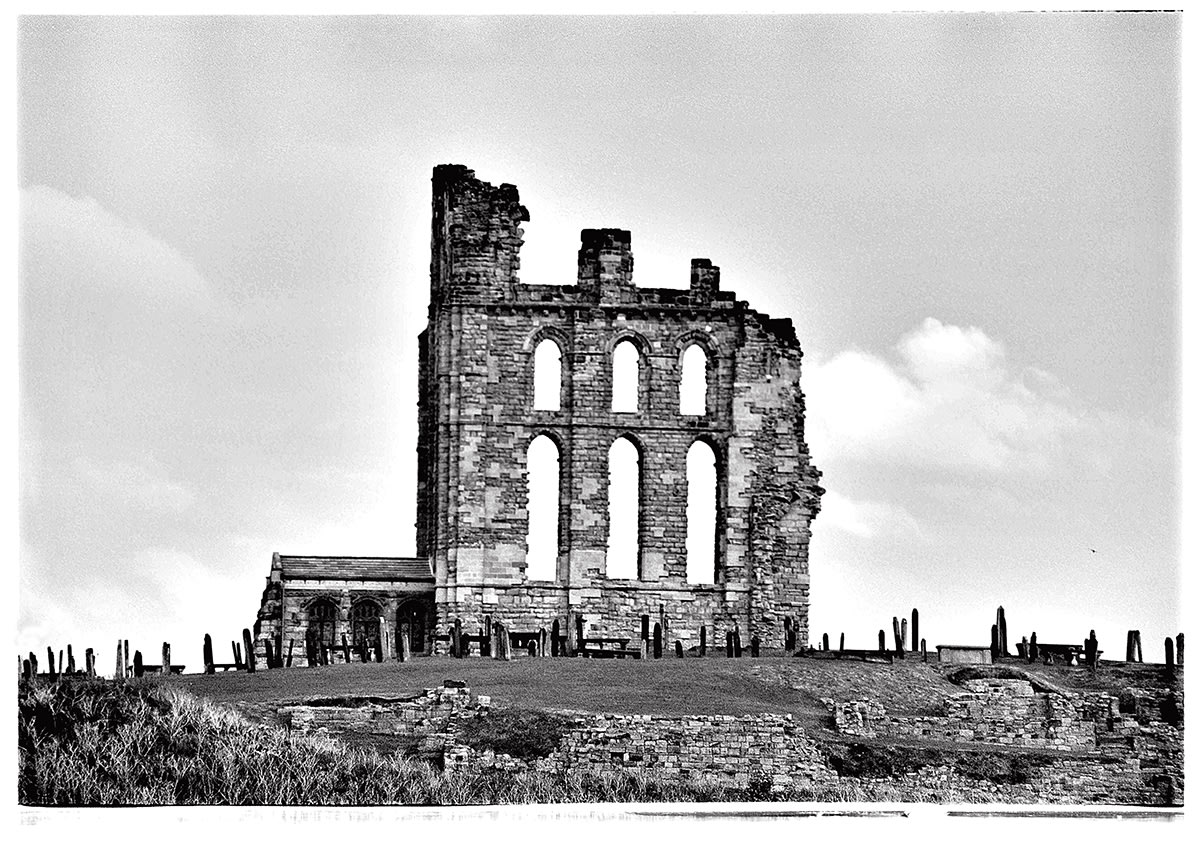
Stand on the headland at Tynemouth and you stand where Anglo-Saxon monks prayed over the bones of murdered kings, where Norman walls rose against Scottish armies, where Turner painted the ruins against a blazing sky, and where gun batteries defended the Tyne through two World Wars. The Priory beneath your feet is a royal tomb. The sea in front of you carried Viking longships, Roman supply galleys, and the rescue boats that gave Tynemouth the oldest volunteer life brigade in the world. Fourteen centuries of history compressed into a single dramatic headland at the mouth of a great northern river.
A Northumbrian Place
Tynemouth was part of Northumberland for over 1,300 years. From the Anglo-Saxon Kingdom of Northumbria through to the medieval county, through the Tudor and Stuart eras, through the Georgian and Victorian periods, right up until 1 April 1974 — Tynemouth was Northumberland. The Local Government Act of 1972 redrew the map, creating the metropolitan county of Tyne and Wear and placing Tynemouth in the new borough of North Tyneside. It was a bureaucratic pen stroke, not a cultural one. The rocks didn’t move. The Priory didn’t move. The history didn’t move. Only the line on the map changed.
The headland sits at the south-eastern corner of what was historically called Tynemouthshire — an ancient parish encompassing Chirton, Cullercoats, Monkseaton, Murton, North Shields, Preston, and Whitley. Seven thousand acres of Northumberland soil, with the Priory at its heart. For a thousand years, if you stood on this headland and looked north, you were looking along the Northumberland coast. You still are.
The boundary change matters to administrators. It does not matter to the stone, to the sea, or to the story. Tynemouth’s history is inseparable from Northumberland’s. The monks who built here came from Lindisfarne and Jarrow. The kings who were buried here ruled Northumbria. The soldiers who defended the castle fought in Northumberland’s wars. To tell the story of one without the other would be to break something that was never meant to be broken.
Three Kings Beneath the Priory
The heraldry of North Tyneside still carries three crowns. They represent the three kings buried at Tynemouth Priory — a claim almost no other site in England can match. Westminster has its monarchs. Canterbury has its martyrs. Tynemouth has its murdered kings and its warrior saint, lying beneath the ruins at the edge of the North Sea.
| King | Died | The Story |
|---|---|---|
| St Oswine, King of Deira | 651 AD | Betrayed and murdered at Gilling on the orders of King Oswiu of Bernicia. His body was brought to Tynemouth for burial. Oswiu, wracked with guilt, founded or endowed the monastery in penance — a church built on the blood of a king. Oswine was later venerated as a saint, and his shrine became one of the great pilgrimage destinations of the medieval North. |
| Osred II, King of Northumbria | 792 AD | Buried at Tynemouth in preference to Jarrow, Wearmouth, or Lindisfarne — a powerful statement about the Priory’s standing among Northumbrian monasteries. When a king could have been laid to rest anywhere in the kingdom, they chose the headland above the Tyne. |
| Malcolm III, King of Scotland | 1093 | Killed at the Battle of Alnwick on 13 November 1093 by forces under Robert de Mowbray, Earl of Northumbria. His body was carried south to Tynemouth Priory alongside his son Edward, who died of wounds from the same battle. Malcolm was later exhumed and reburied at Dunfermline Abbey in 1115 — but for twenty-two years, a King of Scotland lay at rest in Northumbrian ground. |
The Shrine of St Oswine
The murder of Oswine at the hands of Oswiu is one of the foundational events of the Kingdom of Northumbria. The two sub-kingdoms — Bernicia in the north (roughly modern Northumberland) and Deira in the south (roughly Yorkshire) — were locked in a rivalry that defined the politics of 7th-century Britain. Oswine was, by all accounts, a good king. Bede called him a man of great humility and generosity. His murder was political, not personal — and Tynemouth became the burial ground of that betrayal.
The monastery that grew around Oswine’s tomb would stand for nearly a thousand years. In 1065, his burial site was rediscovered, and his relics were elevated to a place of honour. On 20 August 1110, the Shrine of St Oswine was ceremoniously transferred to the new Norman church — a moment of great significance that drew pilgrims from across the North. The shrine made Tynemouth holy ground. People came to pray, to seek healing, and to touch the tomb of a king who had died rather than shed the blood of his own people.

The First Monastery
The origins of the monastery are older than the written record can confirm with certainty. The most likely founding date is the mid-7th century, sponsored by Northumbrian royalty in the years following Oswine’s murder. The Venerable Bede — writing from nearby Jarrow, just a few miles up the Tyne — records an Abbot Heribald at Tynemouth who died in 745. By that date the monastery was well-established, part of the great network of Northumbrian religious houses that included Lindisfarne, Jarrow, Wearmouth, Whitby, and Hexham.
These were not simple churches. The Northumbrian monasteries of the 7th and 8th centuries were centres of extraordinary learning and artistry — the same tradition that produced the Lindisfarne Gospels, Bede’s Ecclesiastical History, and some of the finest illuminated manuscripts in European history. Tynemouth was part of this golden age. Its monks looked out across the same cold sea as the monks of Lindisfarne, prayed to the same God, followed the same rule, and feared the same enemy that would eventually come from across that sea.
The Vikings and the Long Decline
The enemy came in 793, when Viking raiders struck Lindisfarne in an attack that sent shockwaves across Christendom. The Northumbrian coast was no longer safe. Tynemouth was raided too — the monastery survived, but the world around it was transformed. The great Kingdom of Northumbria fragmented. The lands north of the Tyne became a rump state centred on Bamburgh, while the lands between the Tyne and the Tees were granted to the Community of St Cuthbert. Tynemouth sat right at this boundary — a border monastery in a broken kingdom.
The monastery endured through the centuries of upheaval that followed. It was damaged, rebuilt, damaged again. By the time of the Norman Conquest in 1066, it was diminished but still standing — a survivor of invasions, civil wars, and three centuries of uncertainty. The Normans would give it new life, though not without controversy.
The Norman Priory
After the Conquest, the priory was refounded as a Benedictine house — but under the control of St Albans Abbey in Hertfordshire, over 250 miles to the south. This was a deeply controversial arrangement. Northumbrian monks resisted what they saw as southern interference for generations. The Priory of Tynemouth belonged to Northumberland in every way that mattered — geographically, historically, spiritually — yet its governance sat in the hands of an abbey that had never seen the North Sea.
Despite this tension, the Norman period saw the Priory rebuilt on a grand scale. A magnificent new church rose on the headland, its east window framing the open sea. The Shrine of St Oswine was installed with ceremony in 1110. The Priory became wealthy from pilgrimage, from its lands, and from its fishing rights on the Tyne. At its peak, Tynemouth Priory was one of the most important religious houses in the North of England — a powerhouse of faith, commerce, and influence perched on a cliff above the waves.
Fortress on the Headland
The castle grew alongside the priory because the headland was too strategically important to remain unwalled. Commanding the mouth of the Tyne, the site controlled access to one of the most important rivers in northern England. By the 13th century, Tynemouth was both holy site and military stronghold, its walls enclosing monks and soldiers alike.
The castle was besieged during the Wars of Scottish Independence in 1296 — part of the same chain of conflict that saw Berwick sacked, Dunbar fought, and the whole of the North thrown into turmoil. It was besieged again in 1390. During the Wars of the Roses it changed hands more than once. When Henry VIII dissolved the monasteries in 1539, the Priory died but the castle lived on — its military value outlasting its spiritual purpose by centuries.
During the English Civil War, the castle was held by Royalist forces and besieged by the Parliamentarians. The headland saw cannon fire, starvation, and eventually surrender. The ruins of the Priory, already crumbling, took further damage from the fighting — a monastery founded in penance for a king’s murder, now scarred by another English war.
The Coastal Defences
The military story didn’t end with the Civil War. During the First World War, gun batteries were installed on the headland to defend the Tyne against German naval attack. The river was vital to the war effort — the shipyards of the Tyne built warships, and the coal that powered the fleet flowed out through its mouth. Tynemouth’s headland became part of the coastal defence network that protected the North East throughout both World Wars.
In the Second World War, the batteries were upgraded and the headland bristled with anti-aircraft guns. The remains of these emplacements are still visible among the Priory ruins — concrete gun positions sitting incongruously beside medieval stonework, two very different kinds of defence separated by seven hundred years but serving the same purpose: protecting what lies upriver.
The Painters’ Headland
The ruins drew artists like a flame draws moths. J.M.W. Turner visited Tynemouth and painted the Priory — the dramatic silhouette of broken arches against sky and sea captured exactly the kind of sublime landscape that defined the Romantic era. Turner understood what the headland offered: a collision of human ambition and natural power, ancient stone giving way to wind and wave, the beautiful wreckage of time.
The American painter Winslow Homer spent the years 1881–1882 at neighbouring Cullercoats, just along the coast from Tynemouth. He came as an established artist and left as a transformed one. The watercolours he produced during those months — powerful, elemental images of fisherfolk hauling nets, women watching the sea, boats struggling against the swell — are considered among the finest of his career. Art historians regard the Cullercoats period as the turning point that made Homer one of America’s greatest painters. The Tynemouth coastline did that to him.
They were not alone. Throughout the 19th century, painters were drawn to this stretch of coast for its light, its drama, and its subjects. The fishing communities of Cullercoats and North Shields offered human stories set against an unforgiving sea. The Priory ruins offered romance and melancholy. And the headland itself — that narrow finger of rock pointing east into the North Sea — offered a view that no artist could resist.
The Lifeboat Tradition
The Tynemouth Volunteer Life Brigade, founded in 1864, is the oldest volunteer life brigade in the world. It was born out of necessity — the mouth of the Tyne was one of the most dangerous stretches of water on the English coast, where the river’s current met the open sea in conditions that could turn lethal without warning. Ships were wrecked on the Black Middens rocks with terrible regularity, sometimes within sight of shore, and the people of Tynemouth could do nothing but watch.
The Brigade changed that. Volunteers — ordinary men with extraordinary courage — trained to rescue crews from stricken vessels using rocket-fired lines and breeches buoys. They stood the same watches that lifeboatmen stood at Seahouses, at Amble, at Boulmer, and at every station along the Northumberland coast. The tradition runs in an unbroken line from Tynemouth to Berwick and beyond, the same tradition that produced Grace Darling on the Farne Islands in 1838. The sea gives and the sea takes, and Northumbrians have always rowed out to meet it.
The Tyne and the Romans
Two miles upriver at Wallsend stands Segedunum — the eastern terminus of Hadrian’s Wall. The name means “strong fort”, and for nearly three centuries it marked the point where the Wall met the river and, by extension, the sea. Every Roman supply ship entering the Tyne would have passed beneath the headland where the Priory now stands. Grain, weapons, reinforcements, dispatches — all flowed past this point on their way to the garrisons of the Wall.
No confirmed Roman fort has been found at Tynemouth itself, though Roman altars and coins have been discovered in the area. The headland would have been an obvious lookout point — the Romans understood the strategic value of river mouths as well as anyone — but the archaeological evidence for a permanent Roman presence remains thin. What is certain is that the Tyne was a Roman highway, and Tynemouth was its gatehouse. The connection to Hadrian’s Wall is not one of shared masonry but of shared geography: the same river, the same frontier, the same purpose of watching the North.
King Edward’s Bay
Below the Priory headland, sheltered from the worst of the north-east winds, lies King Edward’s Bay — one of the finest small beaches on the North East coast. The name commemorates King Edward II, who is said to have sheltered here. The bay is a natural harbour of sorts, a crescent of sand protected by the headland on one side and the Long Sands on the other. On a calm day it is idyllic. On a rough day the waves crash against the rocks below the Priory walls and the whole headland shakes with the force of the North Sea doing what it has always done.
For surfers, swimmers, and walkers, King Edward’s Bay is a destination. For the Priory above, it was always more than that — it was the monks’ view, the soldiers’ shoreline, and the fishermen’s landing. Stand on the beach and look up at the ruins and you see thirteen centuries of human endeavour framed against the sky.
Often Licked, Never Beaten
No account of Tynemouth would be complete without the ice cream vans. They’ve been parked along the seafront for as long as anyone can remember — a permanent fixture of the headland, as much a part of the landscape as the Priory itself. Carlo’s, with its hand-painted lettering and its unapologetic slogan, is the kind of thing that makes Tynemouth what it is: ancient history and a 99 with a flake, side by side, neither one diminishing the other.
There is something deeply Northumbrian about this. A place that takes its history seriously enough to preserve a thousand-year-old priory, but not so seriously that you can’t eat an ice cream while looking at it. The monks would probably have approved.

Visit Tynemouth
Tynemouth Priory & Castle is managed by English Heritage. Open year-round (seasonal hours). The headland walk gives views across the river mouth to South Shields and north along the coast toward St Mary’s Lighthouse and Whitley Bay.
King Edward’s Bay — the sheltered beach beneath the Priory headland. One of the best small beaches on the North East coast.
Tynemouth Station — the beautifully restored Victorian metro station hosts a popular weekend market.
Further Reading
Comprehensive history of the Priory and Castle from Anglo-Saxon foundation to 20th century coastal defence.
english-heritage.org.ukOverview of the site’s history, architecture, and significance.
wikipedia.orgThe Anglo-Saxon kingdom that encompassed Tynemouth, Lindisfarne, Bamburgh, and the great Northumbrian monasteries.
englandsnortheast.co.ukRelated Articles
Article researched and written April 2026. Sources include English Heritage, the National Archives, and Bede’s Ecclesiastical History.