

On the night of 19 August 1388, two armies met in the wooded valley of Redesdale, near the village of Otterburn in what is now Northumberland National Park. The Scottish force was led by James Douglas, 2nd Earl of Douglas. The English were led by Sir Henry Percy — known as Hotspur, the same man Shakespeare would later immortalise in Henry IV, Part 1. They fought by moonlight. Douglas was killed leading a charge. Percy was captured. And the battle produced not one but two of the most celebrated ballads in the English language.
This page tells the story of the battle. For the full two-thousand-year context — Roman Dere Street, the medieval pele tower, the reivers, the Victorian mill, the modern firing range — see our companion deep-history page.
The Raid
The battle began, as so many border conflicts did, with a raid. In the summer of 1388, a large Scottish force crossed into England in two columns. The western army struck into Cumberland. The eastern force — led by the Earl of Douglas with perhaps three to four thousand men — swept south through Northumberland, burning and pillaging as they went.
Douglas reached the walls of Newcastle itself. There, according to the chroniclers, he fought a skirmish outside the gates with Sir Henry Percy and captured Percy's pennant — his personal banner. It was a deliberate provocation. Douglas taunted Percy, daring him to come and reclaim it. Then he turned north, moving slowly, burning as he went, and made camp near Otterburn in Redesdale.
Percy took the bait. Against the advice of more cautious men, he gathered what force he could — perhaps five to eight thousand, though the numbers are disputed by every source — and rode north in pursuit. He reached Otterburn on the evening of 19 August.
The Moonlit Fight
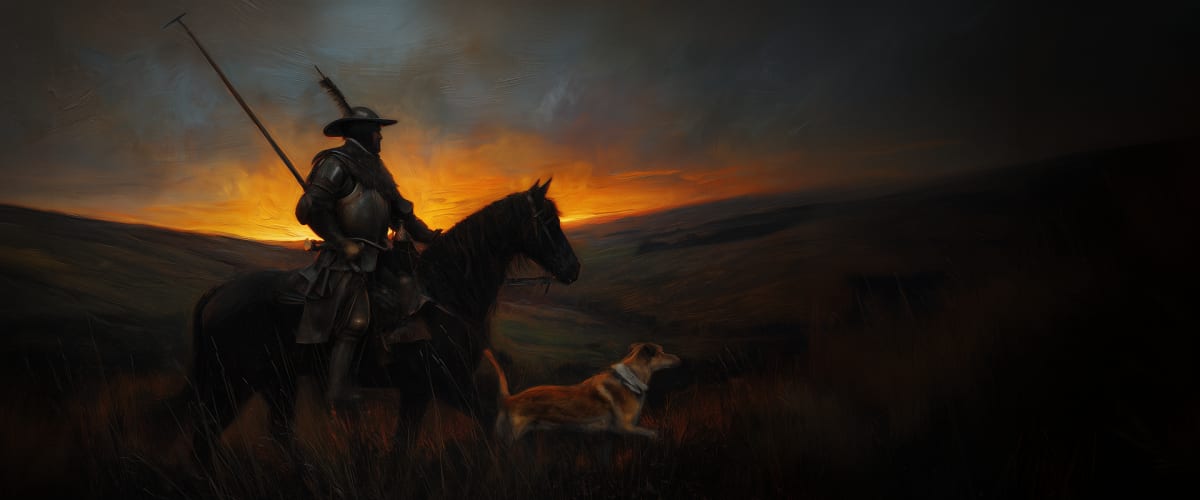
Percy attacked at dusk. It was a decision that would have seemed reckless in any century — launching an assault at the end of a long march, against a fortified camp, with darkness falling. But Hotspur was not a cautious man. He had earned his nickname precisely because of his impulsive aggression. He was twenty-four years old.
The initial English assault drove into the Scottish camp. For a time, it looked as if Percy would carry the position. But Douglas rallied his men and led a flanking counterattack through the woods — a manoeuvre that only works if your troops know the ground and can fight in darkness. The Scots did, and they could.
Douglas was killed during this charge. The accounts vary: some say he was struck down by three lance wounds, others that he fell to a mace blow. What all the sources agree on is that he ordered his men to fight on, and that his standard was raised over his body to prevent the Scots from realising their commander was dead. The ruse worked. The Scottish counterattack broke the English line. Percy was captured, along with his brother Ralph and a number of other English knights.
Of all the battles and fierce encounters that I have made mention of heretofore in this history, this was one of the sorest and best fought, without cowardice or faint hearts. — Jean Froissart, Chronicles, c.1390 — the French chronicler's account of Otterburn
Froissart's Account
Jean Froissart — the great French chronicler of the Hundred Years' War — gave Otterburn one of the most detailed accounts of any medieval battle. He had access to eyewitnesses on both sides and described the fighting with an immediacy that still reads vividly six centuries later. He was struck by the ferocity of the engagement and by the unusual circumstance of a battle fought largely by moonlight. Medieval armies almost never fought at night. The risks of confusion, friendly fire, and loss of command were too great. That Percy chose to attack at dusk, and that the fighting continued into darkness, speaks to the intensity of the personal rivalry between the two commanders.
Froissart also recorded the detail that Douglas, mortally wounded, ordered his men to raise his banner and continue fighting. It was this combination — the moonlight, the personal challenge, the death of the victorious commander, the capture of the defeated one — that made Otterburn irresistible to the ballad makers.
The Ballads
The Battle of Otterburn
The Scottish version of the ballad — known simply as "The Battle of Otterburn" — tells the story from Douglas's perspective. It celebrates the Scottish victory and the heroic death of Douglas, who fights on even after receiving his mortal wounds. The ballad circulated widely in Scotland and was eventually collected by Sir Walter Scott and included in Minstrelsy of the Scottish Border.
The Ballad of Chevy Chase
The English version — "The Ballad of Chevy Chase" — shifts the focus to Percy and transforms the battle into a hunting expedition gone wrong. It became one of the most famous and widely quoted ballads in the English language. Sir Philip Sidney, the Elizabethan poet and soldier, wrote that the ballad stirred his heart more than any trumpet. Joseph Addison devoted two essays in The Spectator to its merits. Ben Jonson is said to have declared he would rather have written "Chevy Chase" than all his own works.
The ballad survived in oral tradition for centuries before being written down. Its popularity crossed class boundaries in a way that few medieval works achieved. It was sung in alehouses and recited in great halls. It was, in every sense, a folk masterpiece.
Hotspur's Afterlife
Percy was ransomed and returned to England. His career was far from over. Fifteen years after Otterburn, in 1403, the same Hotspur rebelled against King Henry IV — the man he had helped put on the throne — and was killed at the Battle of Shrewsbury. Shakespeare took this story and made it the dramatic heart of Henry IV, Part 1, giving Hotspur some of the most memorable speeches in the English language.
The connection between Otterburn and Shrewsbury, between the young knight captured by moonlight and the rebel killed in his prime, gave Hotspur's story a tragic arc that Shakespeare recognised and exploited. The man who rode north to reclaim his pennant from Douglas in 1388 died fighting his own king in 1403. He was thirty-nine years old.


The Road to Otterburn
The Battlefield Today
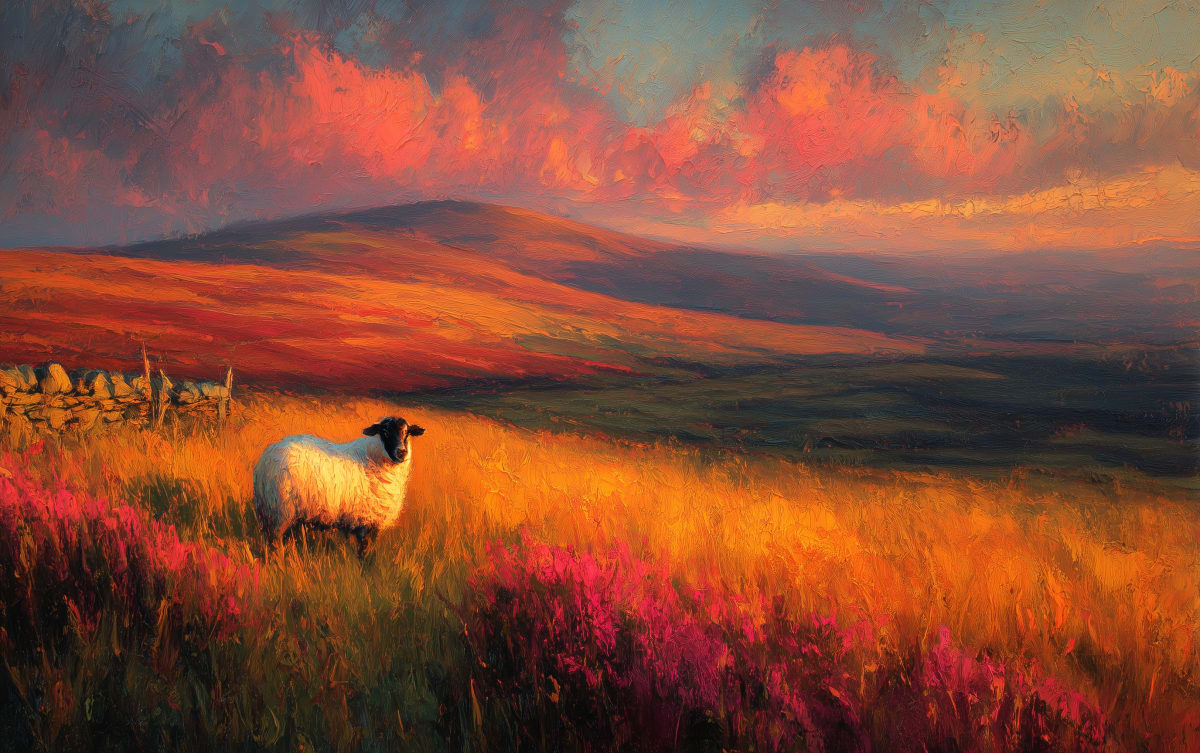
The battlefield at Otterburn lies on open moorland in Redesdale, now within Northumberland National Park. The Percy Cross — a medieval stone cross marking the traditional site of the battle — still stands in a field beside the road. It is signposted and accessible on foot. The village of Otterburn itself is a small, quiet settlement on the A696, with a tower house (now a hotel) and the parish church of St John, which contains fragments of medieval stonework.
Elsdon, a few miles to the east, is often associated with the battle's aftermath. The church of St Andrew in Elsdon contains a mass grave — hundreds of skeletons discovered in the nineteenth century, believed to be casualties of Otterburn. The village also has a well-preserved pele tower, a reminder that this was border country where violence was never far away.
Stand at the Percy Cross on an August evening, with the light fading over Redesdale and the moorland stretching empty in every direction, and the events of 1388 feel very close. The landscape has not changed. The silence is the same silence that fell after the fighting stopped. Only the men and their reasons are gone.
Visiting the Battlefield
The Percy Cross — Signposted from the A696 near Otterburn. Short walk from the road across a field. Open access, free. The stone cross marks the traditional site where Douglas fell.
Elsdon Village — St Andrew's Church contains the mass grave of battle casualties. The pele tower is visible from the village green. Elsdon is one of the most atmospheric villages in Northumberland.
Otterburn Mill — A water-powered woollen mill that operated for over 150 years and supplied tweed and blankets to British polar expeditions (Scott, Shackleton). The mill closed in 2025; the buildings remain a landmark on the A696 just north of the village.
The battlefield is within the Otterburn Training Area (MoD). Check firing range schedules before visiting — some areas may be closed on training days. The Percy Cross is normally accessible.